
For any passionate pianist, the sound of their instrument is paramount. When that rich, complex tone suddenly turns dull, flat, or muted, it’s deeply unsettling. This immediate change raises the crucial question: Why does my piano sound muffled?
As craftsmen and technicians dedicated to preserving the world-class instruments in the Bethesda area, we understand that a muffled piano is often a symptom of underlying mechanical or environmental stress. Pinpointing the exact cause, whether it’s a simple foreign object, a complex regulation issue, or the inevitable effect of age on felt components, is the first step toward restoring the piano’s clear, resonant voice. This guide will help you understand the common culprits and when it is time to call in a trusted professional.
A muffled piano sound is most often caused by compacted hammer felt that needs professional voicing, damper failure that keeps the strings muted, or environmental factors such as high humidity that can swell the internal wood and felt parts.
The Common Culprits: Why Your Piano’s Voice is Silenced
The true beauty of an acoustic piano lies in its precision. Hundreds of moving parts must align perfectly for a single note to resonate fully. When an owner asks, why does my piano sound muffled, the answer usually involves a breakdown in one of these critical relationships.
The Hammer
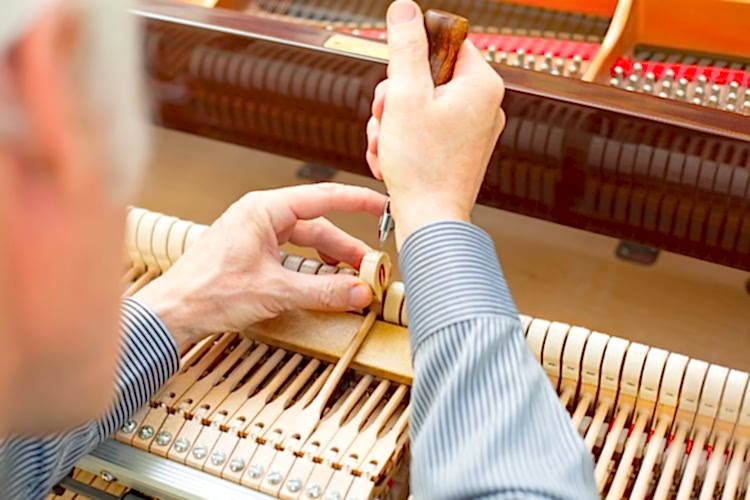
The most frequent offender is the hammer itself. After years of service, the soft felt covering the wooden hammer cores becomes compressed and hardened at the point of contact with the strings. This hardening prevents the hammer from striking the strings with the proper elasticity, dampening vibration, and eliminating the rich harmonic spectrum that defines a clear tone. This condition requires professional filing and voicing to restore the original profile and fiber resilience.
The Dampers
Another common cause is damper failure. The dampers are felt pads that rest on the strings until a key is pressed, at which point they are lifted, silencing the strings. If the dampers are misaligned, swollen due to humidity, or have lost their spring tension, they may not lift completely, leaving a slight, continuous pressure on the strings. This partial damping is the definition of a muffled sound. Similarly, if the dampers fail to fall back onto the strings completely when the key is released, the result can be a blurring of notes rather than a clean, precise attack.
The Environment
Finally, the piano's environment plays an enormous role. Like any finely crafted instrument made of wood and felt, the piano is acutely sensitive to changes in temperature and humidity. Winter weather, in particular, stands as the primary culprit behind many tonal problems. When cold temperatures arrive, heating systems dry out indoor air dramatically, often dropping relative humidity to dangerously low levels—sometimes below 30% or even 20%. This arid winter environment causes the piano's wooden components to contract and shrink as moisture is pulled from their fibers. Soundboards lose their crown, bridges settle, and pinblocks can loosen their grip on tuning pins. The felt components throughout the action—hammers, dampers, and bushings—also dry out, become brittle, or compress, losing their resilience.
Conversely, excessive humidity during other seasons can cause the felt in the action (including the hammers and dampers) to swell, becoming sluggish and absorbing sound, which directly answers the question: Why does my piano sound muffled?
However, it is the harsh, dry conditions of winter that most frequently wreak havoc on piano performance, creating friction between moving parts, causing keys to stick, dampers to fail, and hammers to lose their ability to strike with proper speed and power. For owners seeking a definitive resolution to these complex tonal issues, we offer a comprehensive piano service that addresses everything from basic tuning to full action regulation and voicing.
Loose Objects
Simple foreign objects are also surprisingly frequent causes. Pencils, coins, dust bunnies, or small toys can slip past the keybed and wedge themselves into the action assembly, physically blocking a hammer or damper from moving correctly. This prevents the hammer from accelerating fully or stops the damper from lifting, resulting in a distinct, muted note. A skilled technician can often quickly diagnose and remove these obstructions, instantly returning the piano’s original voice.

When the Muffle Turns to Twang: Addressing Pitch Issues
While a muffled tone often speaks to the condition of the hammer or damper felt, a completely different complaint arises when the sound is not dull, but simply jarring. Owners usually ask, "Why does my piano sound twangy?" A tinny or“twangy” sound is nearly always a result of severe unison issues, meaning the multiple strings assigned to a single note are out of tune with each other. Most keys use three strings (a “unison” group) to create their tone. When these three strings vibrate at slightly different frequencies, the sound becomes chaotic, fluttering, and—yes—twangy. This issue is resolved through precision tuning.
The longer a piano goes without proper maintenance, the more likely these problems are to compound. This brings up a vital question often posed by long-term owners: Does tuning a piano ruin it? While neglecting tuning will not physically shatter the soundboard or compromise the piano's structural integrity, it will cause long-term damage to the instrument's musical capabilities. A piano’s strings are under immense tension, often exceeding 20 tons in total force. When left untuned, this tension drops unevenly, causing internal components to settle into the incorrect pitch environment. This makes future tuning exponentially more difficult, potentially requiring pitch raises or multiple service calls to stabilize the instrument.
If a piano has been silent for decades, the task is more significant. We frequently hear: Can a piano be tuned after 20 years? The answer, in the vast majority of cases, is yes, but it is rarely a single, quick tuning. An instrument that has sat for 20 years will be dramatically flat, far below the standard concert pitch (A440). Attempting to bring the tension up in one go risks breaking the delicate, aged strings and stressing the frame. A technician must perform a pitch raise, a coarse, preventive tuning designed to distribute the tension evenly and gradually bring the entire instrument closer to standard pitch. Only after this initial, stabilizing pitch raise can the fine, precision tuning be performed.
In rare and unfortunate cases, a piano may reach a point of no return, leading owners to question: Can a piano become untunable? While our extensive rebuilding and restoration services mean nearly any piano can theoretically be restored, a piano may be considered practically untunable if it exhibits severe structural failure. This includes a cracked or compromised cast iron plate, a loose pin block (the laminated wood where the tuning pins are seated), or a soundboard that has entirely lost its “crown” or arch. In these cases, the tuning pins cannot hold the necessary tension, and the structural repairs required often approach or exceed the cost of replacing the instrument entirely. However, if the structure remains sound, our expert technicians can restore the pin block and other failing components to ensure the piano can once again hold a stable tune.
Action & Key Mechanics: Beyond Just Muffled Sounds
The sound of a piano is not solely about the string and the hammer; it is fundamentally about the smooth, predictable operation of the keys and the entire action assembly. Muffled tones or pitch issues are one category of ailment, but other symptoms point directly to the action mechanism.
Addressing the Silent Notes
A key that depresses but produces either no sound or a faint, unsatisfactory click is described as "dead." A worried owner will often ask: What causes dead keys on piano? A dead key is usually a symptom of severe friction, breakage, or misalignment within the key's action. Causes include:
- Broken or Disconnected Parts: The complex mechanism contains many small wooden, felt, and leather components (like whippens, repetition levers, or shanks). If one of these snaps or comes loose from its center pin, the connection between the key and the hammer is broken.
- Severe Friction: Felt bushings inside the keys or action components can swell due to humidity, causing the center pins to clamp down and making movement sluggish or impossible. A key that feels heavy or "stuck" often has this issue.
- Hammer Return Failure: If the hammer rail or backcheck is faulty, the hammer may be held too close to the strings after a note is played (or even before), effectively damping the vibration and yielding a “dead” or severely muted note.
Diagnosing a dead key requires careful action regulation, often involving replacing or re-bushing the affected parts to eliminate excess friction and restore precise motion.

When the Key Won’t Move
Related to the dead key is the problem of mechanical resistance. An owner facing this might inquire: How do you fix a stiff piano key? Three main factors can cause a stiff or sticking key, all related to friction and wood movement:
- Swollen Key Bushings: The key runs on two or three felt bushings (front rail, balance rail). If these bushings absorb moisture, they swell and pinch the key pin, making the key extremely difficult to press. The fix involves drying the key and easing the bushings (re-boring them slightly) to allow for free, smooth movement.
- Key-to-Key Friction: Wood is organic and shifts over time. Keys may rub against their neighbors, especially in high humidity. A technician must carefully file the sides of the keys to create the necessary clearance, allowing them to travel independently.
- Action Component Binding: Sometimes, the stiffness is higher up in the action. Excessive friction at the hammer or whippen heel, usually caused by dirt, corrosion, or swollen felt, can translate resistance back to the key. Cleaning, lubrication, and regulation of the expert piano technicians are necessary to bring the touchweight back to its intended standard. Restoring the smooth, rapid repetition of the key is vital to the player’s experience.
Changing the Voice: Intentional Sound Modification
Not every muffled or softer sound is a fault; sometimes, the piano’s natural sound is too bright or too loud for the environment. The question, how do you soften piano sounds, refers to the intentional modification of the piano's inherent tone—a process known as voicing.
Voicing is the art of adjusting the density and resilience of the hammer felt to achieve a uniform, aesthetically pleasing tone across the keyboard, matching the room's acoustics and the pianist's preferences. When a piano is too bright or harsh, the hammers are too hard. The technician softens the tone by strategically pricking or needling the felt with specialized tools. This process relaxes the fibers deep within the hammer, allowing them to compress more uniformly and reducing the number of high-frequency harmonics, resulting in a warmer, more mellow tonal palette overall. Conversely, if a tone is too dull, hardening solutions can be sparingly applied to the striking point. The delicate balance and physics of this process are key to the instrument's quality, a concept explored in depth in this technical maintenance guide on piano hammer design.
Beyond professional voicing, there are also mechanical systems designed to soften the piano for practice temporarily:
- The Practice Pedal (Mute Rail): Found on most upright pianos (the center pedal), this lowers a strip of soft felt between the hammers and the strings, significantly muting the volume for late-night practice.
- The Una Corda Pedal (Soft Pedal): On grand pianos, this shifts the entire keyboard and action assembly laterally, causing the hammers to strike only two of the three strings for each note (or one of the two in the lower tenor). This softens the tone and changes the timbre, though it does not cause the muffled sound of a defect.
Reviving an Antique: Restoring the Muffled Piano
When dealing with a decades-old instrument, muffling symptoms are often related to its age and wear. This leads to the fundamental query: How do I repair an old piano? Repairing or restoring an old piano is a multi-phase commitment that goes far beyond a simple tuning. It is a preservation project that requires the most profound understanding of piano craftsmanship, which aligns perfectly with PianoCraft's ethos.
The restoration process usually includes:
- Structural Cleaning and Inspection: The piano is first thoroughly cleaned. Years of accumulated dust, dirt, and debris contribute significantly to muffled tone and sluggish action. Technicians inspect the pin block, the soundboard, and the bridges' structural integrity.
- Regulation: Regulation is the intricate mechanical process of adjusting the hundreds of components in the piano action to correct for friction and wear. Every component, from the key height to the let-off (the point at which the hammer disengages from the action), must be calibrated to thousandths of an inch. A piano that is heavily out of regulation will have inconsistent, weak, or loud notes—a far cry from the rich, expressive tone it was built to produce.
- Hammer Re-Shaping and Voicing: As noted, aged hammers become grooved and hardened. They must be filed, re-shaped, and then voiced to restore the ideal tone. If the felt is too thin or damaged beyond repair, a complete set of replacement hammers may be required.
- Rebuilding the Action: If the piano is truly ancient, simple repairs won't suffice. Rebuilding involves replacing all the action's cloth, felt, and leather components. This includes the hammer butts, bridle straps, key bushings, and whippens. Since these are the components most susceptible to humidity and wear, replacing them is the ultimate solution to permanently eliminate friction and the resulting muffled or weak notes.
Professional Diagnosis: When to Call Your Piano Technician
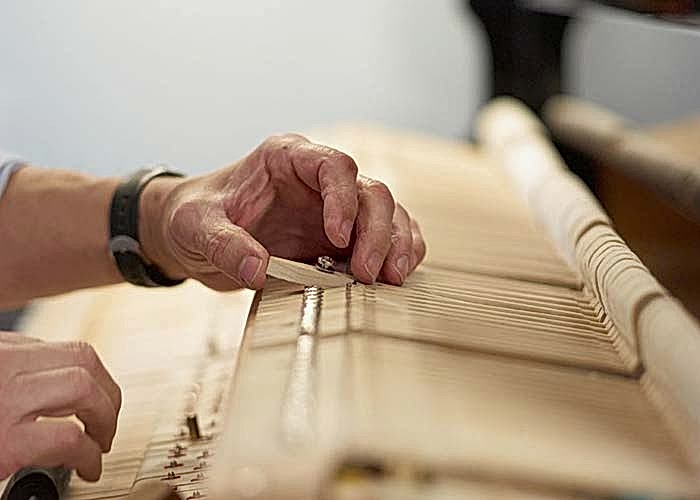
If you find yourself constantly asking, "Why does my piano sound muffled despite my basic cleaning attempts?" the issue has moved beyond simple maintenance. Tonal problems, especially those involving the hammer felt, the dampers, or the delicate regulation of the action, are not DIY fixes. They require specialized knowledge, tools, and decades of experience.
Bringing Your Piano’s Voice Back Into Focus
The muffled sound of a beloved piano is a call for attention, often signaling the need for high-level care, such as voicing or regulation. Ignoring this symptom allows environmental changes and natural wear to take an even deeper toll on the instrument's performance and value. By entrusting your piano to the passion and expertise of our team, you ensure that its structural integrity and magnificent voice are protected and preserved for generations. Contact Bethesda Piano Tuning by PianoCraft today to restore the clarity and brilliance of your instrument.
Leave a Reply